
Frequently Asked Questions
The FAQ's we get asked by people with regard to Capricorn Mohair Socks
Washing
We recommend you wash Capricorn Mohair Socks on a warm wash cycle in a washing machine at 40 degrees Celsius, or hand wash. Do NOT tumble dry.
A few simple habits will keep your socks in good shape for years. Turning them inside out before washing helps clear away the grit and dead skin that collects on the inside after a long day on the hills. It's the trapped debris, more than the walking itself, that wears socks out. Wash them with similar colours, and use a mild, non-biological detergent. Biological powders contain enzymes designed to break down protein, and because mohair is a natural protein fibre, over time those enzymes can do the same to your socks.
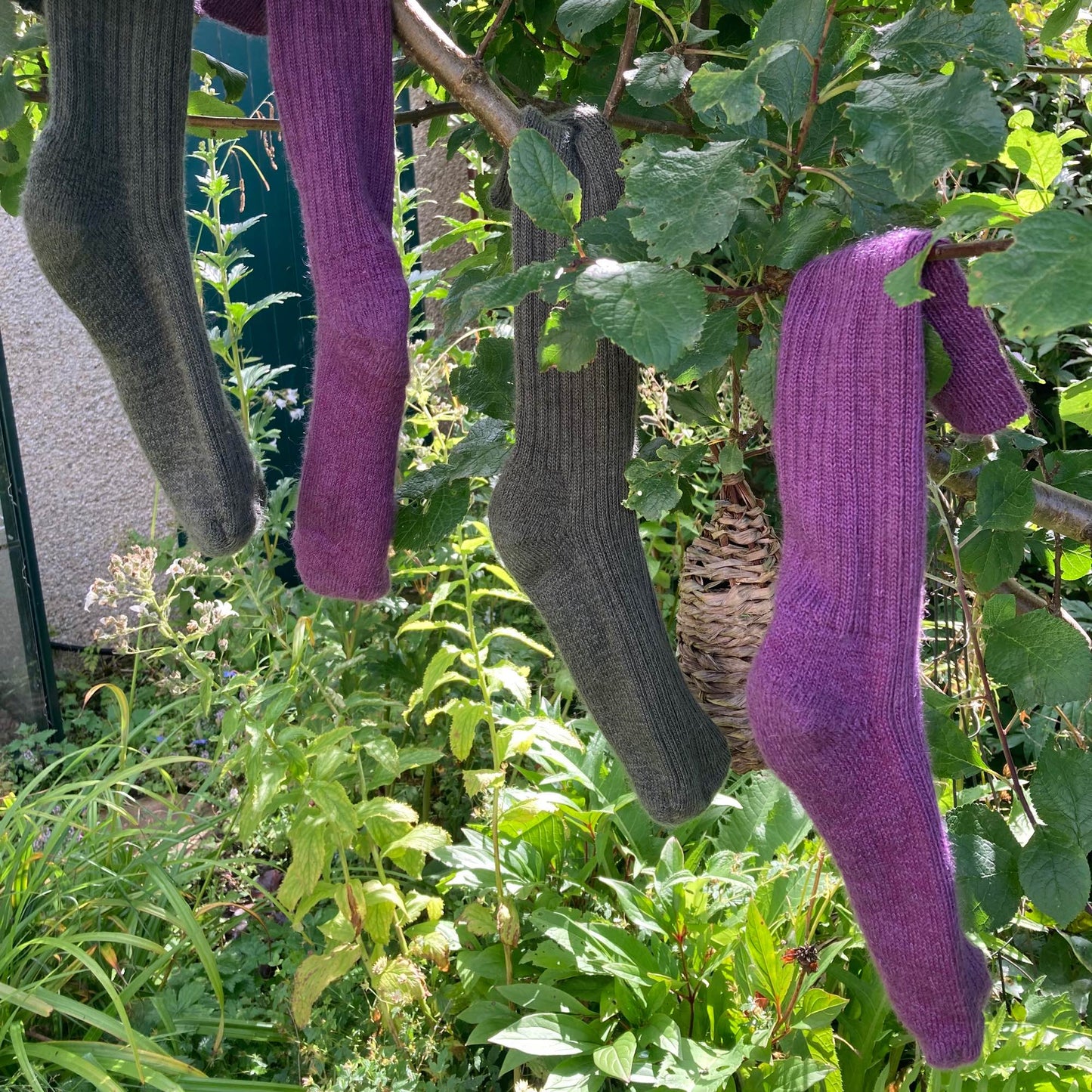
To dry them, reshape gently and lay them flat or hang them somewhere airy, away from direct heat. Avoid draping them over a radiator or popping them near the fire to speed things up. The reason we say no to tumble drying is the same reason we'd steer you away from radiators as mohair doesn't like high heat combined with agitation. That combination causes the fibres to shrink and felt together, and once that's happened there's no undoing it. A little patience at the drying stage is what keeps a good pair of mohair socks going for season after season.
We recommend you wash Capricorn Mohair Socks on a warm wash cycle in a washing machine at 40 degrees Celsius, or hand wash. Do NOT tumble dry.
A few simple habits will keep your socks in good shape for years. Turning them inside out before washing helps clear away the grit and dead skin that collects on the inside after a long day on the hills. It's the trapped debris, more than the walking itself, that wears socks out. Wash them with similar colours, and use a mild, non-biological detergent. Biological powders contain enzymes designed to break down protein, and because mohair is a natural protein fibre, over time those enzymes can do the same to your socks.
To dry them, reshape gently and lay them flat or hang them somewhere airy, away from direct heat. Avoid draping them over a radiator or popping them near the fire to speed things up. The reason we say no to tumble drying is the same reason we'd steer you away from radiators as mohair doesn't like high heat combined with agitation. That combination causes the fibres to shrink and felt together, and once that's happened there's no undoing it. A little patience at the drying stage is what keeps a good pair of mohair socks going for season after season.
It's very unlikely, but as a precaution we'd suggest washing your socks separately for the first few washes, just in case. After that they're fine to go in with everything else.
Our socks are knitted in Leicester and dyed in Leeds, with the colour fixed firmly into the fibre, so colour run is rare. That said, natural fibres like mohair can release a little surplus dye in the first wash or two. It's normal for quality dyed wool and mohair, not a sign anything's wrong. To be safe, wash new socks separately, or with similar dark colours, for the first few washes. After that, pop them in with the rest of your load without a second thought. Worth knowing: the biggest cause of colour fading isn't run at all, it's washing too hot and drying on a radiator. A 40 degree wash and drying flat keeps the colour richer for longer.
It's very unlikely, but as a precaution we'd suggest washing your socks separately for the first few washes, just in case. After that they're fine to go in with everything else.
Our socks are knitted in Leicester and dyed in Leeds, with the colour fixed firmly into the fibre, so colour run is rare. That said, natural fibres like mohair can release a little surplus dye in the first wash or two. It's normal for quality dyed wool and mohair, not a sign anything's wrong. To be safe, wash new socks separately, or with similar dark colours, for the first few washes. After that, pop them in with the rest of your load without a second thought. Worth knowing: the biggest cause of colour fading isn't run at all, it's washing too hot and drying on a radiator. A 40 degree wash and drying flat keeps the colour richer for longer.
Not normally. Follow the washing instructions, a 40 degree wash and NO TUMBLE DRYING and your mohair socks will hold their shape and size wash after wash.
Mohair socks only tend to shrink when they're exposed to the two things natural fibres dislike most, high heat and heavy agitation. Get those wrong and the fibres can felt together and tighten up, which is what people usually mean when they say wool or mohair has shrunk.
To dry, reshape gently and lay them flat or hang them somewhere airy, away from radiators and direct heat.
Capricorn mohair socks will keep their fit and feel for years. One of the advantages of a quality UK-made sock over cheaper synthetic ones.
Not normally. Follow the washing instructions, a 40 degree wash and NO TUMBLE DRYING and your mohair socks will hold their shape and size wash after wash.
Mohair socks only tend to shrink when they're exposed to the two things natural fibres dislike most, high heat and heavy agitation. Get those wrong and the fibres can felt together and tighten up, which is what people usually mean when they say wool or mohair has shrunk.
To dry, reshape gently and lay them flat or hang them somewhere airy, away from radiators and direct heat.
Capricorn mohair socks will keep their fit and feel for years. One of the advantages of a quality UK-made sock over cheaper synthetic ones.
Don't panic, simply soak them in hair conditioner. It relaxes the fibres and lets you gently reshape the socks back towards their original size. Any cheap conditioner will do the job.
Fill a bowl or sink with lukewarm water, stir in a generous squeeze of hair conditioner, and pop the socks in to soak for around 30 minutes. There's a bit of science behind it. Mohair, like your own hair, is a natural protein fibre, and the conditioner coats the fibres and relaxes them, easing apart the scales that have tightened up in the heat.
Once they've soaked, lift them out without rinsing too aggressively, and gently ease and stretch them back into shape while they're still damp. Then lay them flat to dry, away from radiators and direct heat.
Don't panic, simply soak them in hair conditioner. It relaxes the fibres and lets you gently reshape the socks back towards their original size. Any cheap conditioner will do the job.
Fill a bowl or sink with lukewarm water, stir in a generous squeeze of hair conditioner, and pop the socks in to soak for around 30 minutes. There's a bit of science behind it. Mohair, like your own hair, is a natural protein fibre, and the conditioner coats the fibres and relaxes them, easing apart the scales that have tightened up in the heat.
Once they've soaked, lift them out without rinsing too aggressively, and gently ease and stretch them back into shape while they're still damp. Then lay them flat to dry, away from radiators and direct heat.
Mohair
As a former shepherd, this is a hard one for me to answer honestly, because I've a lot of time for a good fleece. But the key thing to understand is that mohair isn't actually a wool at all, it's a hair taken from the Angora goat, and that difference is where its advantages come from.
Being a hair, mohair is a straight fibre, whereas wool is naturally crimped and wavy. That straightness matters more than you'd think. It means mohair holds very little moisture, so it wicks sweat away from the skin and dries quickly rather than staying damp against your foot.
It's also remarkably hard-wearing; mohair is famously strong for its weight, with some people claiming a fibre is stronger than steel of the same diameter, which gives your socks real longevity. On top of that it's naturally soft against the skin and genuinely breathable, staying comfortable across a wide range of temperatures.
The other half of the story is the surface of the fibre: sheep's wool is covered in prominent overlapping scales, whereas mohair's scales are flatter and barely raised. Those smooth scales are why mohair feels less prickly, why it doesn't felt and mat the way wool can, and why there's nowhere for the bacteria that cause odour to take hold. It's the same reason you can air a pair overnight and wear them fresh the next morning.
As a former shepherd, this is a hard one for me to answer honestly, because I've a lot of time for a good fleece. But the key thing to understand is that mohair isn't actually a wool at all, it's a hair taken from the Angora goat, and that difference is where its advantages come from.
Being a hair, mohair is a straight fibre, whereas wool is naturally crimped and wavy. That straightness matters more than you'd think. It means mohair holds very little moisture, so it wicks sweat away from the skin and dries quickly rather than staying damp against your foot.
It's also remarkably hard-wearing; mohair is famously strong for its weight, with some people claiming a fibre is stronger than steel of the same diameter, which gives your socks real longevity. On top of that it's naturally soft against the skin and genuinely breathable, staying comfortable across a wide range of temperatures.
The other half of the story is the surface of the fibre: sheep's wool is covered in prominent overlapping scales, whereas mohair's scales are flatter and barely raised. Those smooth scales are why mohair feels less prickly, why it doesn't felt and mat the way wool can, and why there's nowhere for the bacteria that cause odour to take hold. It's the same reason you can air a pair overnight and wear them fresh the next morning.
No, mohair socks aren't itchy for most people. As a smooth, straight hair rather than a crimped wool, mohair sits softly against the skin, and where reactions do occur they're more often caused by the dye than the fibre itself.
The itch people associate with wool comes largely from coarse, crimped fibres and their tendency to prickle against the skin. There's actually a name for it in the textile world, the prickle threshold. Fibres coarser than about 30 microns are stiff enough to bend the tiny nerve endings in the skin rather than flex around them, and that's what you feel as prickle. Below that, fibres soften off and behave themselves.
Mohair is different. As a smooth, straight hair rather than a wool, it sits more softly against the foot, which is why most people find mohair socks comfortable to wear next to the skin and why the fibre carries such a luxurious reputation. Its scales are flatter and less raised than sheep's wool too, so even where the fibre diameters overlap, it tends to feel kinder against the skin. It's also worth saying that genuine wool allergy is genuinely rare. Most people who tell us they're allergic to wool have actually been reacting to prickle, or to something used in the dyeing and finishing, rather than the fibre itself. Plenty of walkers who can't bear a woollen jumper get on perfectly well with mohair socks, partly because the skin on your feet is less reactive than the skin on your neck or forearms, and partly because a sock sits inside a boot rather than rubbing against a nerve-rich area.
Here's something worth knowing from experience. When there is a reaction, it's often not the fibre at all, it's the dye. Dyes can carry all sorts, azo compounds, mordants, fixing agents, and once your feet are warm and damp inside a boot, anything the skin isn't keen on has a way of making itself known. If you know you've sensitive feet or react to certain fabrics, we'd point you towards our cream socks, which are left completely undyed. That's the fibre in its purest form, as close to how it comes off the goat as you'll get. With the dye taken out of the equation, they're about as kind to sensitive skin as a sock can be, while still giving you all the moisture-wicking and durability that makes mohair so good underfoot.
No, mohair socks aren't itchy for most people. As a smooth, straight hair rather than a crimped wool, mohair sits softly against the skin, and where reactions do occur they're more often caused by the dye than the fibre itself.
The itch people associate with wool comes largely from coarse, crimped fibres and their tendency to prickle against the skin. There's actually a name for it in the textile world, the prickle threshold. Fibres coarser than about 30 microns are stiff enough to bend the tiny nerve endings in the skin rather than flex around them, and that's what you feel as prickle. Below that, fibres soften off and behave themselves.
Mohair is different. As a smooth, straight hair rather than a wool, it sits more softly against the foot, which is why most people find mohair socks comfortable to wear next to the skin and why the fibre carries such a luxurious reputation. Its scales are flatter and less raised than sheep's wool too, so even where the fibre diameters overlap, it tends to feel kinder against the skin. It's also worth saying that genuine wool allergy is genuinely rare. Most people who tell us they're allergic to wool have actually been reacting to prickle, or to something used in the dyeing and finishing, rather than the fibre itself. Plenty of walkers who can't bear a woollen jumper get on perfectly well with mohair socks, partly because the skin on your feet is less reactive than the skin on your neck or forearms, and partly because a sock sits inside a boot rather than rubbing against a nerve-rich area.
Here's something worth knowing from experience. When there is a reaction, it's often not the fibre at all, it's the dye. Dyes can carry all sorts, azo compounds, mordants, fixing agents, and once your feet are warm and damp inside a boot, anything the skin isn't keen on has a way of making itself known. If you know you've sensitive feet or react to certain fabrics, we'd point you towards our cream socks, which are left completely undyed. That's the fibre in its purest form, as close to how it comes off the goat as you'll get. With the dye taken out of the equation, they're about as kind to sensitive skin as a sock can be, while still giving you all the moisture-wicking and durability that makes mohair so good underfoot.
Mohair is one of the most durable natural fibres you can put on your feet. As a straight, smooth hair it's remarkably strong for its weight and resists the wear and abrasion that quickly thins out cheaper socks, so a well-looked-after pair will happily last a number of years rather than a single season. That durability is a big part of why mohair socks work out better value than they first appear, as you purchase far fewer pairs over time.
How long yours last comes down partly to how you treat them. The socks that wear out early are almost always the ones washed too hot, tumble dried or dried on a radiator, all of which are hard on natural fibres. Stick to a 40 degree wash, dry them flat away from direct heat, and turn them inside out before washing to clear the grit that grinds away at the fibres from the inside. Do that and there's every chance you'll be walking in the same pair years from now.
Most walking socks don't wear out — they get worn out. Hot washes, radiators, and boots half a size too big kill more socks than the miles ever do.
Mohair is one of the most durable natural fibres you can put on your feet. As a straight, smooth hair it's remarkably strong for its weight and resists the wear and abrasion that quickly thins out cheaper socks, so a well-looked-after pair will happily last a number of years rather than a single season. That durability is a big part of why mohair socks work out better value than they first appear, as you purchase far fewer pairs over time.
How long yours last comes down partly to how you treat them. The socks that wear out early are almost always the ones washed too hot, tumble dried or dried on a radiator, all of which are hard on natural fibres. Stick to a 40 degree wash, dry them flat away from direct heat, and turn them inside out before washing to clear the grit that grinds away at the fibres from the inside. Do that and there's every chance you'll be walking in the same pair years from now.
Most walking socks don't wear out — they get worn out. Hot washes, radiators, and boots half a size too big kill more socks than the miles ever do.
It's a fair question, and one we see raised online now and then, so we're always happy to answer it honestly. The biggest single reason is that our socks are made in the UK. That means the people who knit and finish them earn a decent, honest wage for a hard day's work, and that's something we'll support until the end of time. UK manufacturing also comes with legislation that protects those workers, and if doing right by people nudges the price of production up, that's a trade-off we're wholeheartedly behind.
We've all seen the images and videos of how some clothing is made overseas, and frankly, we want no part of that at Capricorn. We'd rather charge a fair price for something we're proud of than shave a few pounds off by cutting corners we couldn't live with.
Then there's the fibre itself. Mohair is a premium natural material that costs more than the synthetics and cheaper wools used in budget socks, but it earns its keep, it wicks moisture, resists wear and stays comfortable across the seasons. Add in genuine durability, and the value equation shifts: a pair that lasts several years works out cheaper over time than repeatedly replacing worn-out socks bought by the multipack.
So while they're not the cheapest socks on the shelf, we'd argue they're some of the best value once you look past the initial price.
It's a fair question, and one we see raised online now and then, so we're always happy to answer it honestly. The biggest single reason is that our socks are made in the UK. That means the people who knit and finish them earn a decent, honest wage for a hard day's work, and that's something we'll support until the end of time. UK manufacturing also comes with legislation that protects those workers, and if doing right by people nudges the price of production up, that's a trade-off we're wholeheartedly behind.
We've all seen the images and videos of how some clothing is made overseas, and frankly, we want no part of that at Capricorn. We'd rather charge a fair price for something we're proud of than shave a few pounds off by cutting corners we couldn't live with.
Then there's the fibre itself. Mohair is a premium natural material that costs more than the synthetics and cheaper wools used in budget socks, but it earns its keep, it wicks moisture, resists wear and stays comfortable across the seasons. Add in genuine durability, and the value equation shifts: a pair that lasts several years works out cheaper over time than repeatedly replacing worn-out socks bought by the multipack.
So while they're not the cheapest socks on the shelf, we'd argue they're some of the best value once you look past the initial price.
Mohair is also naturally breathable and, in a lighter sock, pleasantly cool to wear. That combination of moisture management, breathability and odour resistance is why we'd happily recommend mohair for summer walking, travelling in hot climates, or simply everyday wear when the weather warms up. The same fibre that keeps you warm in winter is quietly keeping you cool in summer it's a proper all-rounder. If you're building a year-round sock drawer, our range covers everything from lighter trainer socks to heavier walking socks.
Our Skye Summer Sock was launched last year, this shorter sock is the perfect trainer sock for those warmer days.
Mohair is also naturally breathable and, in a lighter sock, pleasantly cool to wear. That combination of moisture management, breathability and odour resistance is why we'd happily recommend mohair for summer walking, travelling in hot climates, or simply everyday wear when the weather warms up. The same fibre that keeps you warm in winter is quietly keeping you cool in summer it's a proper all-rounder. If you're building a year-round sock drawer, our range covers everything from lighter trainer socks to heavier walking socks.
Our Skye Summer Sock was launched last year, this shorter sock is the perfect trainer sock for those warmer days.
Mohair earns its reputation because it brings together qualities you don't often find in a single fibre. Before we get into them, it's worth knowing that mohair isn't actually a wool at all, it's a natural hair from the Angora goat, and that structure is where all its advantages come from.
The first is softness. Mohair is smooth and lustrous, without the prickle people associate with coarser wools, which is why it's so often used in high-end knitwear and premium socks. It feels good against the skin from the very first wear.
The second is durability. Mohair is famously strong for its weight, and unlike many fibres it doesn't crush, mat or pill, so it holds its shape and surface far better over time. That resistance to wear is exactly what you want in a walking sock. It means the sock keeps performing and looking good walk after walk, rather than thinning and bobbling after a few outings. It's a big part of why a good pair lasts years rather than months.
The third is that it stays fresh. Because mohair is a smooth hair with none of the scales you find on ordinary wool, it holds almost no moisture, and with no moisture soaking into the fibre, there's nothing for odour-causing bacteria to feed on. So even after a long day on your feet, mohair socks tend not to smell.
The fourth is temperature regulation. The same fibre that keeps you warm in winter is quietly keeping you cool in summer, wicking sweat away and letting your feet breathe when the weather warms up. That's what makes mohair a proper all-rounder rather than a seasonal choice, and it's why a good pair earns its keep in the sock drawer year after year.
Mohair earns its reputation because it brings together qualities you don't often find in a single fibre. Before we get into them, it's worth knowing that mohair isn't actually a wool at all, it's a natural hair from the Angora goat, and that structure is where all its advantages come from.
The first is softness. Mohair is smooth and lustrous, without the prickle people associate with coarser wools, which is why it's so often used in high-end knitwear and premium socks. It feels good against the skin from the very first wear.
The second is durability. Mohair is famously strong for its weight, and unlike many fibres it doesn't crush, mat or pill, so it holds its shape and surface far better over time. That resistance to wear is exactly what you want in a walking sock. It means the sock keeps performing and looking good walk after walk, rather than thinning and bobbling after a few outings. It's a big part of why a good pair lasts years rather than months.
The third is that it stays fresh. Because mohair is a smooth hair with none of the scales you find on ordinary wool, it holds almost no moisture, and with no moisture soaking into the fibre, there's nothing for odour-causing bacteria to feed on. So even after a long day on your feet, mohair socks tend not to smell.
The fourth is temperature regulation. The same fibre that keeps you warm in winter is quietly keeping you cool in summer, wicking sweat away and letting your feet breathe when the weather warms up. That's what makes mohair a proper all-rounder rather than a seasonal choice, and it's why a good pair earns its keep in the sock drawer year after year.
No it is not.
Alpaca comes from the animal it gets its name from, where Mohair comes from Angora Goats.
Alpaca fibre is thinner, which it makes it less durable and cheaper to produce.
No it is not.
Alpaca comes from the animal it gets its name from, where Mohair comes from Angora Goats.
Alpaca fibre is thinner, which it makes it less durable and cheaper to produce.
This is a common question, is Angora and Mohair the same?
Angora wool comes from Angora rabbits, while Mohair comes from Angora goats.
This is a common question, is Angora and Mohair the same?
Angora wool comes from Angora rabbits, while Mohair comes from Angora goats.
People often call Mohair Socks goat socks. This is because manufacturers make them from the fleeces of Angora goats. We have a blog article all about goats socks.
People often call Mohair Socks goat socks. This is because manufacturers make them from the fleeces of Angora goats. We have a blog article all about goats socks.
Nylon in Socks
Mohair has lots of strength and resistance to abrasion, but not much elasticity – so we add a special sort of nylon which augments the nylon but doesn’t detract from it’s benefits.
Mohair has lots of strength and resistance to abrasion, but not much elasticity – so we add a special sort of nylon which augments the nylon but doesn’t detract from it’s benefits.
Why don't they smell?
The fibres of sheep’s wool have scales on them, but mohair fibres are smooth so there is nowhere for foot bacteria to hide. No bacteria = No smell.
Foot odour isn't really about your feet, it's about what your socks are feeding. Smell is caused by bacteria breaking down sweat, so you need three things for socks to end up whiffy: sweat, a fibre that holds moisture, and somewhere for the bacteria to live. Mohair breaks that chain in two places at once.
The fibres of sheep's wool have scales on them, but mohair fibres are smooth, so there's nowhere for foot bacteria to hide. On top of that, mohair holds almost no moisture, so the sweat wicks away and evaporates rather than sitting in the fibre feeding the bacteria in the first place. No bacteria, no smell.
It's a big part of why cotton and thin synthetic socks let people down. Cotton soaks up sweat and holds it against the skin, giving bacteria a warm damp home for the day. Synthetics don't absorb but they hang on to odour compounds wash after wash, which is why gym socks smell even when they're clean. Mohair sits in a category of its own.
The practical upshot is one of our favourite things about the fibre: you can wear a pair, air them overnight, and put them back on the next day without regretting it. That's a genuine godsend on multi-day walks, when you're travelling light, or when the laundry pile is getting away from you. And because a dry foot is a healthy foot, the same properties that keep mohair socks fresh also help keep hot spots, blisters and general foot grumbles at bay.
The fibres of sheep’s wool have scales on them, but mohair fibres are smooth so there is nowhere for foot bacteria to hide. No bacteria = No smell.
Foot odour isn't really about your feet, it's about what your socks are feeding. Smell is caused by bacteria breaking down sweat, so you need three things for socks to end up whiffy: sweat, a fibre that holds moisture, and somewhere for the bacteria to live. Mohair breaks that chain in two places at once.
The fibres of sheep's wool have scales on them, but mohair fibres are smooth, so there's nowhere for foot bacteria to hide. On top of that, mohair holds almost no moisture, so the sweat wicks away and evaporates rather than sitting in the fibre feeding the bacteria in the first place. No bacteria, no smell.
It's a big part of why cotton and thin synthetic socks let people down. Cotton soaks up sweat and holds it against the skin, giving bacteria a warm damp home for the day. Synthetics don't absorb but they hang on to odour compounds wash after wash, which is why gym socks smell even when they're clean. Mohair sits in a category of its own.
The practical upshot is one of our favourite things about the fibre: you can wear a pair, air them overnight, and put them back on the next day without regretting it. That's a genuine godsend on multi-day walks, when you're travelling light, or when the laundry pile is getting away from you. And because a dry foot is a healthy foot, the same properties that keep mohair socks fresh also help keep hot spots, blisters and general foot grumbles at bay.
Allergies and circulation problems
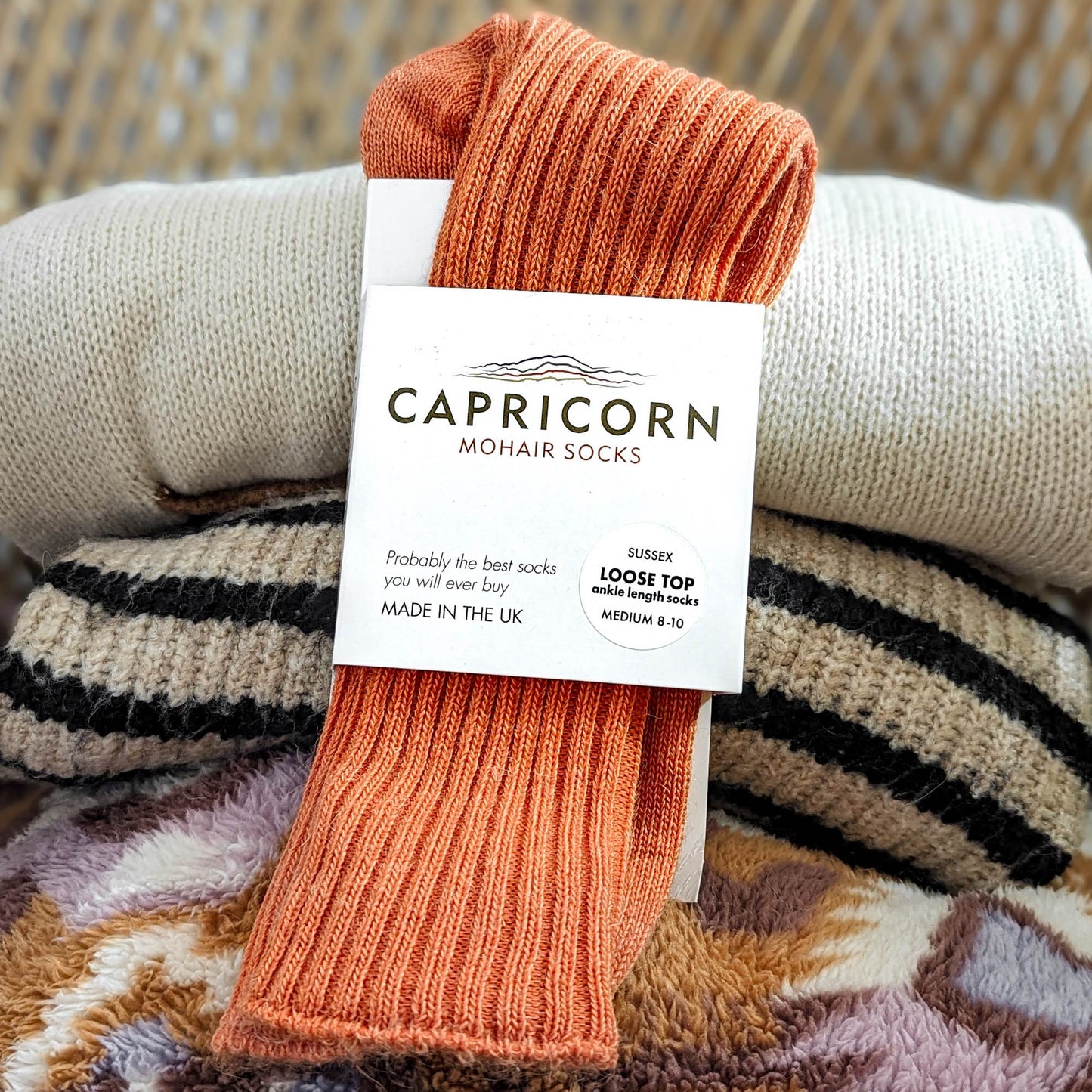
Yes, the Sussex Loose Top style doesn't have an elastic top. Instead, it's ribbed to make it stay up, which matters more than it sounds. A standard elasticated top can leave a mark on the calf even on people with good circulation. For anyone with reduced circulation, ankle swelling, or reduced sensation in the foot who might not notice the pressure, that tight band around the leg is genuinely uncomfortable. The Sussex holds itself up through the knit structure rather than by squeezing the leg.
These socks also have a linked toe, so you don't have that horrible ridge under your toes. Most mass-produced socks are machine-closed at the toe, which leaves a bulky seam that sits right where you feel it. Linking joins the toe stitch by stitch so the join is flat and virtually seamless. It takes longer and costs more, which is why cheaper socks skip it, but for anyone with sensitive feet or fussy toes it's a genuine comfort difference.
The mohair itself supports the same audience. It's warm without being heavy, which matters if your feet run cold, and it wicks moisture away to keep feet dry. That's why we sell lots of these socks to people with diabetes and circulation problems, and to older customers who find standard elastic uncomfortable, or anyone whose feet or ankles tend to swell.
One honest note: we can only speak to what the sock is, not whether it's right for your particular circumstances. If you've a specific condition, it's always worth a quick word with your GP or podiatrist about sock choice.
Yes, the Sussex Loose Top style doesn't have an elastic top. Instead, it's ribbed to make it stay up, which matters more than it sounds. A standard elasticated top can leave a mark on the calf even on people with good circulation. For anyone with reduced circulation, ankle swelling, or reduced sensation in the foot who might not notice the pressure, that tight band around the leg is genuinely uncomfortable. The Sussex holds itself up through the knit structure rather than by squeezing the leg.
These socks also have a linked toe, so you don't have that horrible ridge under your toes. Most mass-produced socks are machine-closed at the toe, which leaves a bulky seam that sits right where you feel it. Linking joins the toe stitch by stitch so the join is flat and virtually seamless. It takes longer and costs more, which is why cheaper socks skip it, but for anyone with sensitive feet or fussy toes it's a genuine comfort difference.
The mohair itself supports the same audience. It's warm without being heavy, which matters if your feet run cold, and it wicks moisture away to keep feet dry. That's why we sell lots of these socks to people with diabetes and circulation problems, and to older customers who find standard elastic uncomfortable, or anyone whose feet or ankles tend to swell.
One honest note: we can only speak to what the sock is, not whether it's right for your particular circumstances. If you've a specific condition, it's always worth a quick word with your GP or podiatrist about sock choice.
In most cases, yes. Mohair is a hair from the Angora goat rather than a wool from sheep, so it doesn't tend to cause the reactions people associate with wool. When people do react to natural fibres, it's often the dye rather than the fibre itself, which is why we offer undyed cream socks for anyone with particularly sensitive skin.
One honest note: if you've a diagnosed wool allergy, we'd suggest trying a single pair first, or having a word with your GP, rather than taking our word for it. Everyone's skin is different, and we'd rather you buy with confidence.
In most cases, yes. Mohair is a hair from the Angora goat rather than a wool from sheep, so it doesn't tend to cause the reactions people associate with wool. When people do react to natural fibres, it's often the dye rather than the fibre itself, which is why we offer undyed cream socks for anyone with particularly sensitive skin.
One honest note: if you've a diagnosed wool allergy, we'd suggest trying a single pair first, or having a word with your GP, rather than taking our word for it. Everyone's skin is different, and we'd rather you buy with confidence.
What sizes are available
In the video below we look at the subject of sock sizes available.
Our socks come in three UK sizes: Small (UK 4–7), Medium (UK 8–10) and Large (UK 11–13). If you shop in US or European sizes, here's a rough guide:
- Small (UK 4–7): EU 37–41, US men's 5–8, US women's 6.5–9.5
- Medium (UK 8–10): EU 42–44, US men's 9–11, US women's 10.5–12.5
- Large (UK 11–13): EU 45–48, US men's 12–14
In the video below we look at the subject of sock sizes available.
Our socks come in three UK sizes: Small (UK 4–7), Medium (UK 8–10) and Large (UK 11–13). If you shop in US or European sizes, here's a rough guide:
- Small (UK 4–7): EU 37–41, US men's 5–8, US women's 6.5–9.5
- Medium (UK 8–10): EU 42–44, US men's 9–11, US women's 10.5–12.5
- Large (UK 11–13): EU 45–48, US men's 12–14
Still need assistance?