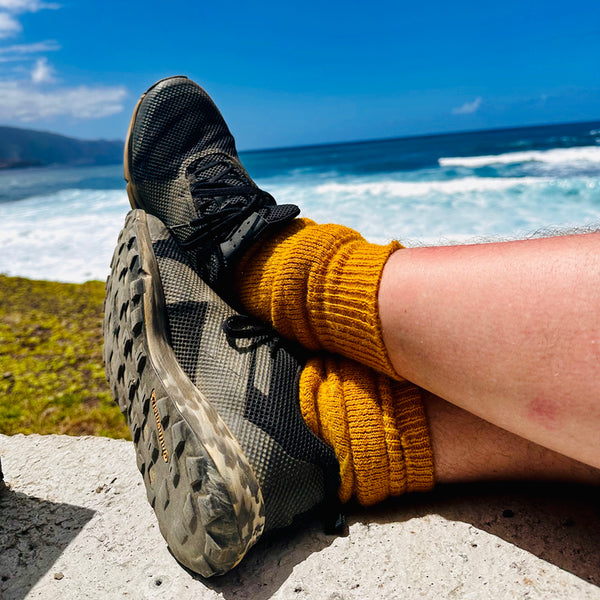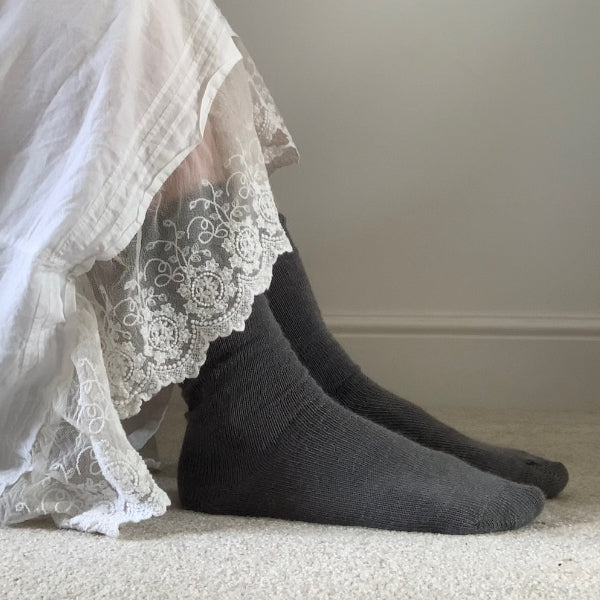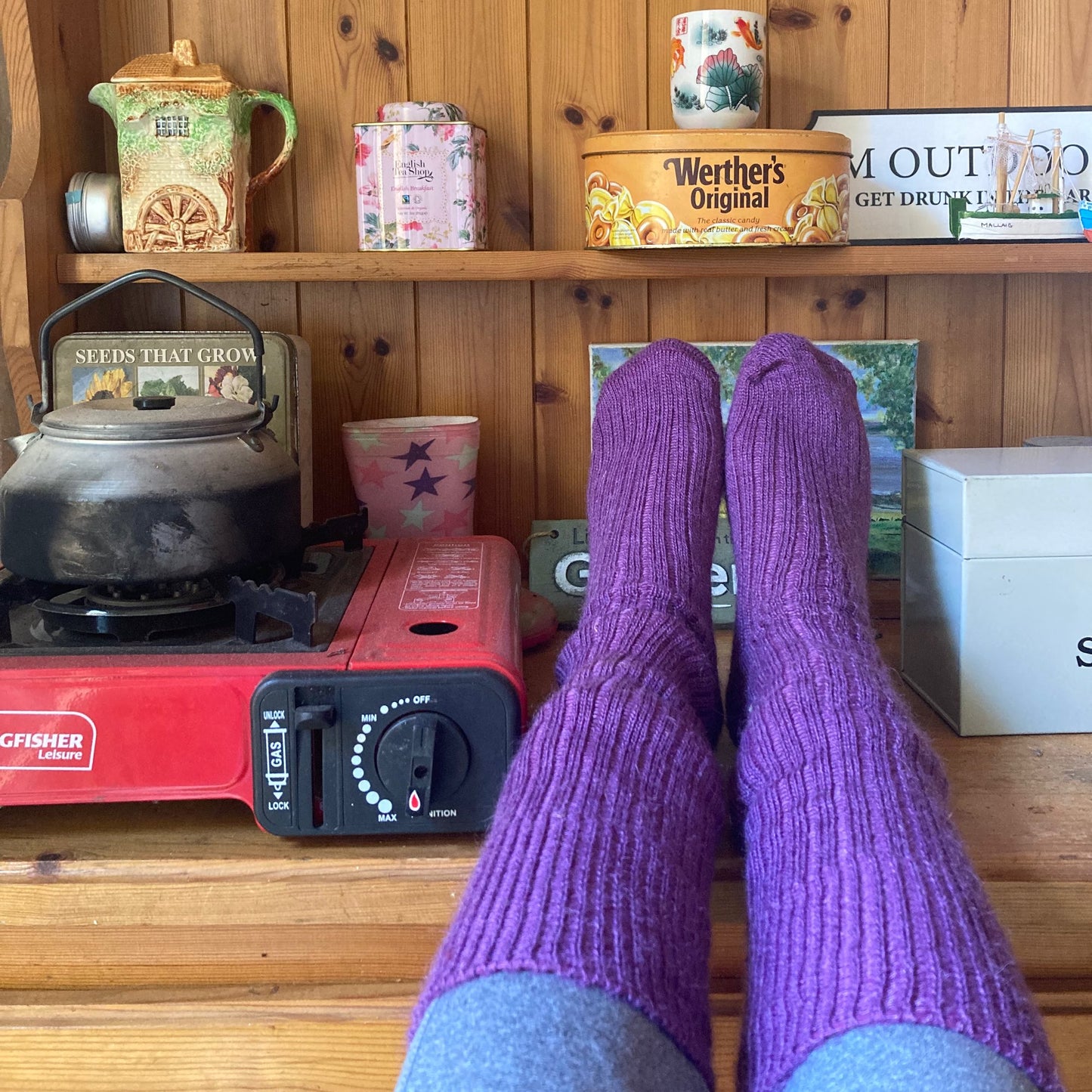


It is the question we are asked more than any other, and the honest answer is that it depends on one thing: what is on your feet.
A sock that is superb inside a stiff walking boot is the wrong sock for a pair of walking trainers, and the other way round. Get that pairing right and most foot problems on a long day simply do not happen.
The short answer
We make two walking socks and between them they cover almost everybody.
- Walking boots - the Derbyshire. Thick, ankle length, heavily cushioned.
- Walking trainers or walking shoes - the Ayrshire. Thinner, with a little give.
That is the decision in a sentence. Here is why each one works.
Derbyshire - the sock for walking boots
The Derbyshire is a thick, ankle-length walking sock, and the thing that makes it is the terry towelling loop that runs from top to toe.
That loop is not padding stitched into the heel and the ball of the foot the way it is on most cushioned socks. It runs through the entire sock, which means there is no thin patch waiting to become a hot spot. Inside a walking boot, where the pressure moves around as the ground changes, that consistency is what keeps the day comfortable.
If you wear boots, or you simply prefer a substantial sock underfoot, this is the one.
See the Derbyshire walking sock
Ayrshire - the sock for walking trainers and shoes
Walking trainers do not have the volume of a boot. Put a thick sock in one and you cramp the fit, which causes as many problems as it solves.
The Ayrshire is our thinner mohair sock, with a small amount of Lycra worked in to give it a bit of stretch and hold its shape against the foot. It has the highest mohair percentage of any sock we make, which tells you where our priorities were when we designed it.
For trail shoes, walking trainers or anything low-volume, this is the right choice - and it is the one many of our customers end up wearing for everyday walking too.
Derbyshire or Ayrshire at a glance
| Derbyshire | Ayrshire | |
|---|---|---|
| Best with | Walking boots | Walking trainers and shoes |
| Thickness | Thick | Thin |
| Cushioning | Terry towelling loop, top to toe | Light, close-fitting |
| Stretch | Ribbed | Small amount of Lycra for give |
| Length | Ankle | Ankle |
Why mohair rather than wool or synthetic
Mohair is hair rather than wool, and that changes how it behaves against your foot.
Wool absorbs moisture and holds it. Cotton is worse - it soaks it up and keeps it there, which is why cotton is the worst choice for walking. Synthetics do not absorb much but they do not move it anywhere either.
With mohair, moisture passes straight through the fibre rather than soaking into it. Three things follow from that, and they are the three things walkers actually care about:
- Fewer blisters. Blisters come from friction, and friction goes up sharply when skin is damp and softened. Keep the foot dry and you remove the cause rather than treating the symptom.
- No smell. Odour needs moisture to develop. Without the damp there is nothing for bacteria to work with.
- Wearable day after day. On a multi-day walk you can wear the same pair repeatedly and they stay comfortable. Rinse them through if you like and they dry overnight.
What about wellington boots, work boots and everything else?
Wellingtons are a different problem - there is no breathability in the boot itself, so the sock is doing all the work. We have covered that separately in the best socks for wellington boots.
If you are on your feet outdoors for work rather than pleasure, the best socks for outdoor workers is the one to read.
A closer look at the range
Your questions answered
What are the best walking socks?
For walking boots, a thick cushioned sock in a fibre that moves moisture - our Derbyshire. For walking trainers or shoes, a thinner sock with a close fit - our Ayrshire. The fibre matters more than the brand: avoid cotton, and look for something that keeps the foot dry rather than something that simply feels soft in the packet.
Should walking socks be thick or thin?
Match the sock to the footwear, not to the weather. A thick sock in a low-volume trainer cramps the fit. A thin sock in a roomy boot leaves the foot moving about. We go into the seasonal side of this in thick vs thin walking socks.
Do I need liner socks?
Usually not, if the main sock is doing its job. Do you really need liner socks? covers when a liner helps and when it just adds bulk.
How many pairs should I take on a walking holiday?
Fewer than you think. How many pairs of socks do you really need for a walking holiday? has the full answer.
What size should I order?
Sizes follow UK shoe sizes and are shown on each product page. Our sock size guide has the complete chart.
Are they machine washable?
Yes. Normal machine wash, no special care needed, and they will not shrink - see does mohair shrink?
Get the right sock for your boots
Boots or trainers, the choice is straightforward once you know which is which.
Shop the Derbyshire (boots) | Shop the Ayrshire (trainers) | Browse all walking socks
UK made - knitted in Leicester, dyed in Leeds. Wear-tested on Northumberland hills.